There’s a moment every pilot remembers—the first effortless lift-off, the quiet surge of thrust, the instant your world rises above traffic and noise. That’s the promise of the Personal Drone Vehicle: fast, intuitive flight in a compact package that fits real life, not just science fiction.
A new class of personal mobility
We’ve had scooters, e-bikes, skateboards, even one-wheelers. All of them made the last mile smoother—but the sky was still off-limits. The Personal Drone Vehicle (PDV) changes that. Think of it as an ultralight, human-scale multicopter built around a protected seat, a smart controller, and a safety-first flight computer. It’s compact enough to store in a garage, powerful enough to cruise above parks or open fields, and—most importantly—easy enough to fly that you don’t need to be a lifetime aviator to feel confident.

What makes this class of craft different isn’t just the form factor; it’s the experience. You strap in, power up, and the vehicle handles the finicky balancing act for you. No collective pitch to manage, no tail rotor to tame. It’s aviation distilled—point where you want to go, and it goes.
Design that serves the pilot | Personal Drone Vehicle
The best PDVs are built around the human body. Everything from the chassis to the seat geometry is engineered to reduce fatigue and boost control. A few hallmarks you’ll notice:
-
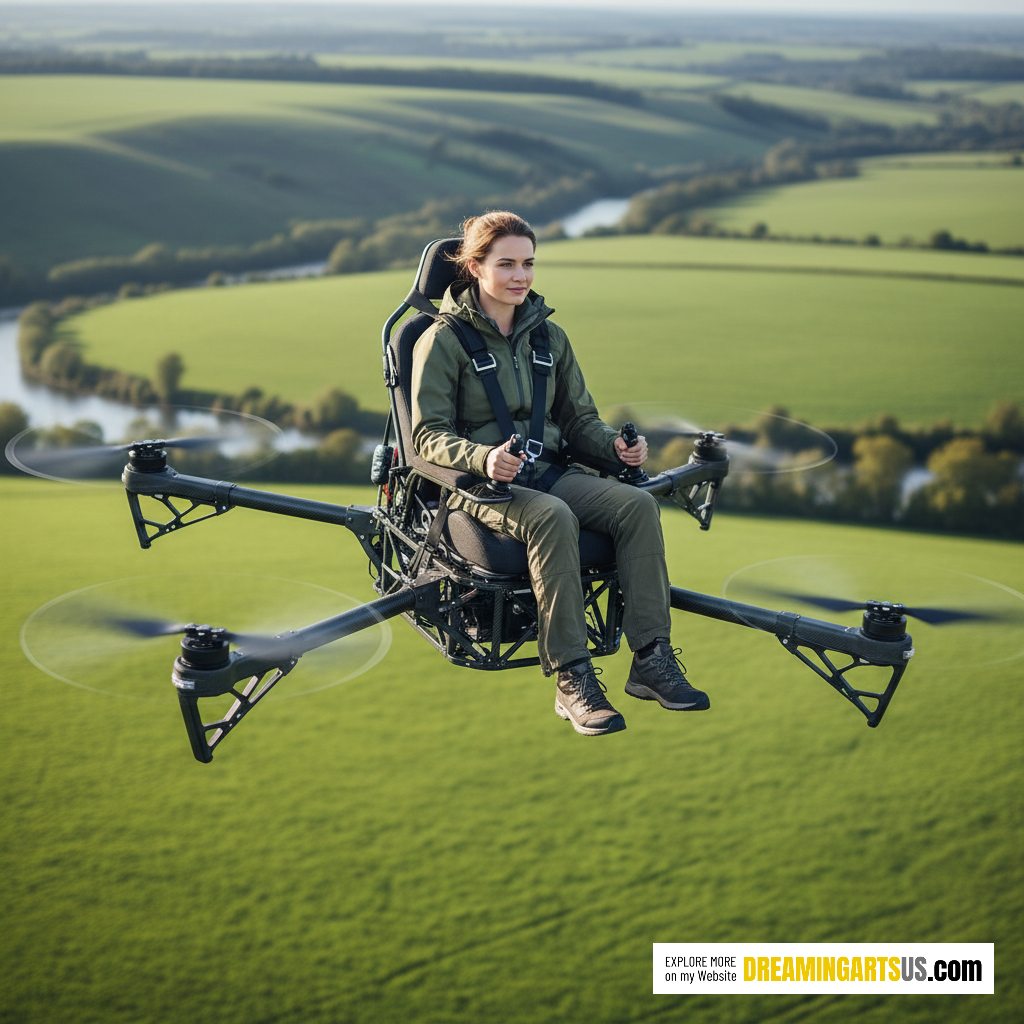
Open-frame carbon architecture: Lightweight yet rigid, carbon tubes form a protective cage around the pilot while keeping weight low for longer flight time.
-
Suspended, ergonomic seat: High-back support, 4- or 5-point harness, and vibration-damped mounting isolate your body from high-frequency motor buzz.
-
Modular arms and motor pods: Foldable booms or quick-release joints let the craft tuck down to a footprint that fits in a pickup bed or small trailer.
-
Rotor protection where it matters: Ducted or guarded rotors reduce the chance of foreign object strikes and provide a safer perimeter on takeoff and landing.
-
Weather-aware lighting: Front navigation bars and perimeter LEDs not only look futuristic; they increase visibility at dawn and dusk.
Every line has a purpose: keep the pilot comfortable, keep the vehicle light, and keep the rotors where they produce clean, efficient thrust.
Power you can feel—and trust
Performance is where the Personal Drone Vehicle earns its stripes. Multi-rotor arrays (commonly 4, 6, or 8) deliver a surplus of lift for rapid climbs and confident hovering. Modern electric powertrains are brutally efficient: high-torque outrunner motors spin large, slow propellers for quiet, low-RPM lift, while high-discharge lithium packs, often paired with supercapacitors, handle bursts without sag.
What that feels like in the seat:
-
Instant response: Nudge the stick and the vehicle leans into motion with no hesitation.
-
Stable hover: The onboard computer micro-adjusts thousands of times per second to iron out gusts.
-
Confident braking: Release forward input and the PDV smoothly arrests speed, holding position precisely.

And underneath the grace is redundancy. Multi-motor designs can tolerate a single motor or ESC fault while maintaining controlled descent. Dual battery buses, dual IMUs, and independent power distribution protect against cascading failures. The result: performance that doesn’t just thrill—it reassures.
“Easy to fly” is not a slogan—it’s a system
If you’ve ever flown a small camera drone, you already understand the brain of a PDV. GPS/GLONASS positioning, barometric altitude hold, inertial measurement, and magnetic heading combine to create an invisible “seat belt” in the sky.
-
Stability modes: For new pilots, the PDV maintains level attitude and a locked position unless commanded otherwise. You won’t drift off course while adjusting your grip.
-
Altitude lock: Dial in a comfortable height and the craft holds it, even across minor terrain changes or breeze.
-
Return-to-Home (RTH): A dedicated button brings the craft back to its takeoff point along a safe, geofenced corridor.
-
Geo-awareness: Preloaded maps and customizable no-fly zones keep you clear of restricted airspace.
-
Training profiles: Many models offer Beginner, Standard, and Sport profiles, gradually increasing sensitivity and top speed as your skills grow.
The feel is simple: you focus on where to go, not how to counteract torque, trim, and drift. That’s what makes the Personal Drone Vehicle so compelling—the learning curve is measured in minutes, not months.
Personal Drone Vehicle: Safety first, second, and third
Aviation rewards respect. Modern PDVs build that respect into their technology:
-
Ballistic parachute options: Pull-cord or auto-deploy chutes can slow descent in the rare case of major failure at altitude.
-
Rotor shielding and landing skids: Keeping distance between prop arcs and ground clutter prevents nicks and tip-overs.
-
Pre-flight diagnostics: The flight computer checks sensor health, battery temperature, cell balance, motor current, and GPS lock before it lets you arm the system.
-
Emergency descent mode: If the system detects a critical voltage drop or navigation fault, it executes a controlled landing at the nearest safe spot.
-
Pilot protection: Harnesses, energy-absorbing seat pans, and roll-cage geometry help manage hard landings.
No system makes risk disappear, but the right layers transform risk into something measurable and manageable—exactly what responsible pilots want.

Batteries, range, and real-world flight time
Let’s talk minutes, because minutes are what you’ll plan around. Entry-level PDVs often offer 12–18 minutes of mixed-profile flight per pack, while higher-end or extended-range configurations can push 20–30+ minutes depending on payload, temperature, and wind. Swappable battery bays (usually two or four packs) keep turnaround fast. Smart chargers balance cells and pre-heat in winter for consistent performance.
Expect the following variables to matter:
-
Weight: Every accessory—from camera gimbals to heavier seats—eats into time aloft.
-
Wind: Gusty days demand more power to hold station.
-
Aggression: Full-throttle climbs and fast sprints trade range for adrenaline.
The sweet spot for most pilots is multiple short sessions: fly 12–15 minutes, land with a safe reserve, swap packs, and repeat. It’s a rhythm that fits casual weekend flying and structured training alike.
Where a PDV shines | Personal Drone Vehicle
The Personal Drone Vehicle is not a commuter helicopter. It’s a personal flight platform that opens up new kinds of freedom and creative work:
-
Recreation & training: Sunrise hovering over empty fields, precision maneuver drills, obstacle courses with cones—pure pilot joy.
-
Aerial scouting: Quick terrain surveys on farms, ranches, or large properties (always respecting local rules and privacy).
-
Adventure filming: Paired with a rugged action camera, you can capture point-of-view footage that no quadcopter can replicate—the pilot is the subject.
-
STEM education & clubs: PDVs are incredible teaching tools for aerodynamics, control systems, and energy management when operated in a controlled environment.
Could PDVs one day support short, permitted hop-commutes across private land? Perhaps, as regulations and infrastructure evolve. For now, the magic is in safe, legal, personal flight experiences that were simply impossible a decade ago.
What to look for when choosing your PDV
1) Flight computer & sensors
Dual-IMU, GPS + GLONASS, downward optical flow, and robust error handling. This is the heart of “easy to fly.”
2) Power system
High-quality ESCs with current monitoring, water-resistant connectors, and motors with proven thermal margins.
3) Battery strategy
Tool-less swappable packs, clear state-of-charge indicators, cell-level telemetry, and brand-name cells.
4) Structure & serviceability
Carbon tubes with replaceable joints, accessible wiring looms, and modular motor pods for quick repairs.
5) Safety options
Guarded rotors, auto-land, geofencing, and parachute compatibility. Non-negotiable for new pilots.
6) Training & support
Vendor-backed tutorials, simulator mode, spare-parts availability, and responsive service channels.
7) Comfort
Ergonomic seat, adjustable armrests, low vibration, smart placement of footrests and controls.
Learning path: from first power-up to confident pilot
Day 1: Simulator time
Many PDVs mirror their control logic in a USB or app-based simulator. Spend an hour practicing lift-off, hovering in a square, and smooth landings.
Day 2: Tethered hover (if available)
Some training kits add a short tether to prevent drift. Focus on throttle discipline and gentle yaw inputs.
Week 1: Pattern work
“Box” patterns at low altitude in a wide, empty field: forward 10 meters, right, back, left, and hold. Add gentle ascents and descents.
Week 2: Precision landings
Place a landing pad and practice approaches from different headings. Introduce mild wind days to build feel.
Week 3+: Emergency drills
Simulate an RTH event. Practice immediate landings. Build the muscle memory you’ll want if a battery sags faster than expected.
Ten disciplined sessions turn a complete beginner into a confident pilot who knows not just how to fly, but how to handle surprises.
Care, maintenance, and longevity | Personal Drone Vehicle
-
Pre-flight: Check propeller tightness, look for nicks, inspect arms and joints, confirm harness integrity, verify GPS lock and battery temps.
-
Post-flight: Log flight time, clean dust from ducts/guards, note any vibrations, and leave batteries at storage charge if you won’t fly for a week.
-
Lifecycle: Props are consumables—replace at the first sign of damage. Keep a spare set of ESCs and arms if you fly often. Firmware updates matter; they often include safety and efficiency improvements.
Treat your PDV like a performance machine and it will reward you with years of reliable sorties.
Cost ranges and value thinking
Entry-level, pilot-only PDVs with basic guards and solid stabilization typically sit in the enthusiast-grade price band. Step up to prosumer-grade and you’ll see better motors, bigger battery bays, enhanced weather sealing, and more robust frames. Top-end, performance-grade builds add ducted fans or advanced composites, higher max takeoff weight, and premium parachute systems.
Refer to similar product models: Click here
Price is only one dimension of value. Also weigh:
-
Parts ecosystem: Are replacement arms, props, and batteries easy to source?
-
Training and documentation: Can you get flying quickly and safely?
-
Resale and upgrade paths: Modular platforms hold value and let you refresh components without starting over.
FAQs about Personal Drone Vehicles
How loud is a Personal Drone Vehicle?
Quieter than a helicopter, louder than an e-bike. Ducted or larger-diameter, slower-spinning props reduce noise. Expect a focused, lower-pitch whir rather than a shriek.
What happens if the wind picks up mid-flight?
Flight controllers manage gusts well up to their rated limit. If winds exceed recommendations, land promptly. Training emphasizes reading conditions before takeoff.
Can I fly at night?
Only if your local rules allow it and your PDV has the required lighting. Night flying adds complexity—master daytime first.
Do I need a license?
Requirements vary by region and by vehicle weight/purpose. Always check your aviation authority’s guidelines and get certified if required.
How do I transport it?
Foldable-arm designs fit in a hatchback or pickup. Hard cases protect motors and electronics. Remove batteries for safe transport.
If the sky has been calling, answer with intention. Choose a platform that prioritizes safety and stability. Invest in training, respect the rules, and build your skills step by deliberate step. When you do, the Personal Drone Vehicle becomes more than a machine—it becomes your most exhilarating hobby, your favorite classroom, and your quietest place to think, all at once.
Compact. Powerful. Easy to control. The future of personal flight isn’t arriving—it’s already humming to life on the nearest field. Strap in, spool up, and meet it there.